LOVE TAKES THE STAGE
With Valentine’s Day on the calendar, February turns our thoughts to love—and few have written about it more memorably that William Shakespeare. While best known for his plays, the Bard was also respected by his peers for his love sonnets. So, this month, Talk of the Town is taking a Shakespearean turn: learning about his love sonnets, traveling to places tied to his legacy, and watching films inspired by his work.

For lovers of literature and history, few cities offer a richer sense of Shakespeare’s world than London. In the late 16th century, the city was alive with theater, river traffic, and creative ferment—and traces of that era remain woven into today’s streets.
Begin along the south bank of the Thames in Southwark, where Shakespeare lived and worked among actors, playwrights, and patrons. This neighborhood was once home to the original Globe and Rose Theatres, as well as taverns, prisons, and palaces that shaped daily life in Elizabethan London. Southwark Cathedral still honors the Bard with a striking stained-glass window, and nearby paths follow the same routes audiences once traveled to attend performances. A visit to the modern Globe Theatre, built close to the original site, offers insight into how plays were staged and experienced in Shakespeare’s time.
Just two hours northwest of London lies Stratford-upon-Avon, Shakespeare’s birthplace and childhood home. Here, half-timbered houses line quiet streets, and the River Avon winds past well-preserved landmarks tied to his early life. The town remains a living center for acclaimed theatrical performances through the Royal Shakespeare Company, blending the town’s heritage with vibrant contemporary theater.
Closer to home, Chicago offers its own connection to the Bard. At Navy Pier, the Chicago Shakespeare Theater presents acclaimed productions year-round, proving that Shakespeare’s stories continue to resonate—whether on the banks of the Thames, in an English market town, or right here on Lake Michigan.

The sonnet is one of poetry’s most enduring forms: just fourteen lines, traditionally written in iambic pentameter. Originally developed in Italy, the sonnet made its way to England in the 1500s, where poets embraced its compact structure as the perfect medium for exploring emotions like love, longing and betrayal.
Shakespeare didn’t invent the sonnet—but he transformed it. Over the course of 154 poems, he stretched the form in unexpected directions, writing about love with a freshness that still feels modern. His sonnets are affectionate, restless, playful, and occasionally skeptical, reflecting love not as an idealized fantasy, but as a deeply human experience.
No poem captures this better than Sonnet 18, which opens with the famous question, “Shall I compare thee to a summer’s day?” Rather than dwelling on the fleeting nature of beauty, the poem celebrates love’s ability to outlast time through art itself—arguing that poetry can grant immortality.
Another favorite, Sonnet 130, offers a witty counterpoint. By rejecting exaggerated compliments, Shakespeare celebrates a love that is honest and grounded, proving that devotion doesn’t require perfection to endure.
Together, these poems reveal why Shakespeare’s love sonnets remain so compelling: they feel honest, modern, and deeply human—perfect reading for February, or any month that invites reflection on love.
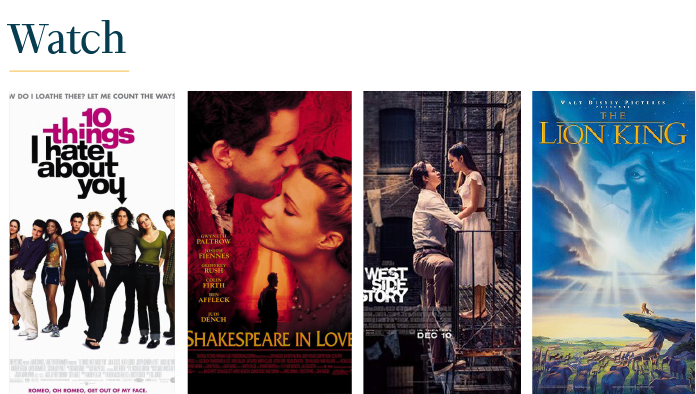
Shakespeare’s stories have traveled far beyond the stage, inspiring films that reimagine his plots for modern audiences. Whether set in high schools, city streets or the African savanna, these adaptations prove that his themes—love, rivalry, and ambition—are timeless.
10 Things I Hate About You (1999): A clever, crowd-pleasing update of The Taming of the Shrew, this teen romantic comedy transforms Shakespeare’s battle of the sexes into late-1990s high school life. With sharp dialogue and undeniable chemistry between actors Heath Ledger and Julia Stiles, it’s a Valentine’s favorite.
Shakespeare in Love (1998): Starring Joseph Fiennes and Gyneth Paltrow, this Oscar-winning film imagines a young Shakespeare finding inspiration—and heartbreak—while writing Romeo and Juliet. It’s playful, poignant, and a love letter to the theater itself.
West Side Story (1961 & 2021): Inspired by Romeo and Juliet, both the original film and more recent version by Steven Speilberg relocate the star-crossed lovers to mid-20th-century New York, where rival gangs replace feuding families.
The Lion King (1994): Loosely inspired by Hamlet, this animated classic introduces Shakespearean drama to a new generation. Both stories center on a murderous uncle—Claudius in Hamlet, Scar in The Lion King—who kills the king and drives the rightful heir into exile in order to seize the throne.
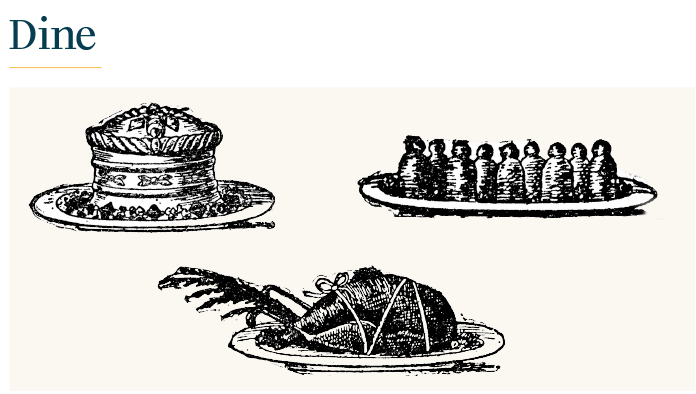
Food in Shakespeare’s time was hearty, spiced, and meant to be shared—an idea that feels especially fitting for February. While few of us are serving elaborate meat pies featuring swan or quail, many Elizabethan flavors translate beautifully to modern tables.
Think roast chicken scented with rosemary and thyme, rich meat pies, or seasonal root vegetables prepared with garlic and leeks. Desserts leaned toward honey, dried fruits, and nuts—early ancestors of today’s fruit tarts and spiced cakes. Mulled wine, known then as “hippocras,” was a popular indulgence, infused with cinnamon, cloves, and ginger.
For a Valentine’s twist, plan a cozy dinner inspired by these flavors, or seek out restaurants like the Pleasant House Pub in Pilsen, famed for their “Royal Pies” featuring beef, chicken, and vegan varieties. Simple, comforting, and meant for sharing—it’s romance, Shakespeare-style.